Galamsey is becoming a food-security crisis as Ghana’s farmlands come under pressure — Ghanaian Farmer CEO
Liwalmor M-Moadan
Journalist
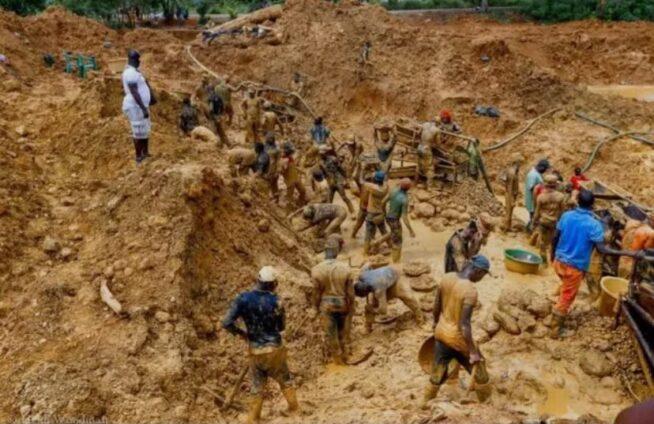
Ghana’s battle against illegal mining is increasingly becoming an economic and food-security challenge, as the destruction of productive agricultural land threatens domestic food production, rural incomes and the country’s ability to feed a growing population.
Enyonam Manye, Chief Executive Officer of The Ghanaian Farmer, has warned that the policy response to illegal mining, commonly known as galamsey, must move beyond concerns about polluted rivers and environmental degradation to recognise the growing threat to agricultural production and national security.
Speaking during the ninth edition of the Loud and Green X Space, Ms Manye argued that Ghana must begin treating fertile agricultural land as a strategic national asset deserving the same urgency and protection afforded to mineral resources.
“First and foremost, we must protect our agricultural land with the same sense of urgency we protect our mineral resources,” she said.
Her intervention highlights an increasingly important dimension of Ghana’s illegal-mining crisis. While much of the national debate has centred on the contamination of water bodies, forest degradation and the environmental consequences of unregulated gold extraction, the conversion and destruction of agricultural land carries potentially significant consequences for food supply and rural economic activity.
Agriculture remains an important source of employment and household income, particularly in rural Ghana. The continued loss of productive land to mining therefore risks creating a chain of economic effects: reduced farm output, weaker farmer incomes, tighter domestic food supplies and potentially greater dependence on imported food.
That could also complicate Ghana’s efforts to maintain price stability. Food represents a significant component of household expenditure, meaning disruptions to domestic agricultural production can feed into consumer prices and put pressure on living standards.
Ms Manye said policymakers should consequently stop treating agriculture and mining as separate economic sectors.
The destruction of farmland, she argued, affects not only farmers but food production, household incomes and the wider economy.
Enforcement must reach the financiers
Ms Manye also called for stronger and more consistent enforcement of Ghana’s laws against illegal mining, arguing that accountability should extend beyond workers physically operating at mining sites.
“Laws against illegal mining must be enforced consistently, regardless of who is involved,” she said.
She criticised an enforcement approach that appears to focus disproportionately on low-level operators while individuals believed to finance, organise or benefit from illegal mining operations escape scrutiny.
“What we are saying is that, no matter who is involved, the person must be made to face the full rigours of the law. Let’s stop using just the boys that we catch at these mining sites as scapegoats because we’ve heard that there are big boys who are involved,” Ms Manye said.
The comments point to a broader governance challenge surrounding illegal mining. Enforcement against workers at mining sites may disrupt individual operations, but without targeting the financing, ownership and commercial networks behind illegal extraction, the economic incentives supporting the activity could remain intact.
A more effective enforcement framework would therefore require authorities to follow financial flows and supply chains alongside conventional policing of mining sites.
Alternative livelihoods need capital
Yet enforcement alone is unlikely to resolve the problem.
Illegal mining provides employment and income in communities where alternative economic opportunities can be limited. Ms Manye said efforts to move young people away from galamsey must therefore be accompanied by credible and commercially viable alternatives.
“It’s not just about telling them that galamsey is no good. We have to make an effort that when we are teaching them how to make money from different sources, we also add some startup capital so that it would help them to start off from scratch,” she said.
The distinction is significant. Skills programmes without access to finance may struggle to compete with the immediate cash incentives associated with informal mining.
For government and development partners, this suggests that alternative-livelihood programmes may need to combine vocational training with affordable financing, market access and business-development support if they are to provide a durable transition away from illegal mining.
Agriculture itself could form part of that alternative, particularly if investment in irrigation, mechanisation, storage and agricultural value chains makes farming more commercially attractive to younger workers.
Restoring the productive base
Ms Manye called for greater investment in irrigation and the restoration of mining-degraded land, alongside stronger support for farmers whose livelihoods have already been affected.
Land restoration carries potentially significant fiscal and economic implications. Once productive agricultural land has been heavily excavated or contaminated, returning it to commercial farming can require substantial investment and years of remediation.
The longer degradation continues, therefore, the greater the potential cost transferred from illegal operators to taxpayers, farming communities and future generations.
The issue also raises questions about Ghana’s long-term development strategy. Gold remains one of the country’s most important export commodities and a major source of foreign exchange. Agriculture, however, underpins food security, rural employment and several domestic industries.
The policy challenge is not necessarily choosing agriculture over mining, but ensuring that mineral extraction does not permanently destroy the productive assets required to sustain other sectors of the economy.
For Ghana, that balance is becoming increasingly urgent.
“When we destroy the land that feeds us, we are directly attacking our economy, public health and national security,” Ms Manye warned.
Her argument reframes galamsey from an environmental problem into a broader question of economic resilience.
If productive farmland continues to disappear, the consequences could eventually be felt far beyond mining communities — through food prices, agricultural employment, import demand and pressure on household incomes.
Protecting Ghana’s agricultural land, therefore, is increasingly not simply a conservation objective. It is becoming an essential component of the country’s food-security and economic strategy.I’m
Written by
Liwalmor M-Moadan
M-Moadan is dedicated journalist committed to delivering accurate, timely, and impactful news. Passionate about uncovering the facts, telling meaningful stories, and keeping the public informed with integrity and professionalism.
Related Stories

Global South Must turn independence into Economic strength - Prof. Opoku-Agyemang
Ghana’s Vice President, Professor Jane Naana Opoku-Agyemang, has urged developing countries to focus on building stronger economies and institutions to make...
Executive Director of VAST Ghana wins second term on Movendi International Board
Mr. Labram Musah Massawudu, Executive Director of Vision for Accelerated Sustainable Development Ghana (VAST Ghana), has been re-elected to the International...
Ghana Takes New Economy Pitch to Bangkok as Dr. Ato Forson Leads Delegation to IMF Annual Meetings
Ghana has arrived in Bangkok for this year's biggest gathering of global finance leaders, with a clear mission to tell the world that the economy has turned...

Comments (0)
No comments yet. Be the first to share your thoughts.