Ghana revokes Adamus mining lease as Minerals Commission takes administrative control
Liwalmor M-Moadan
Journalist
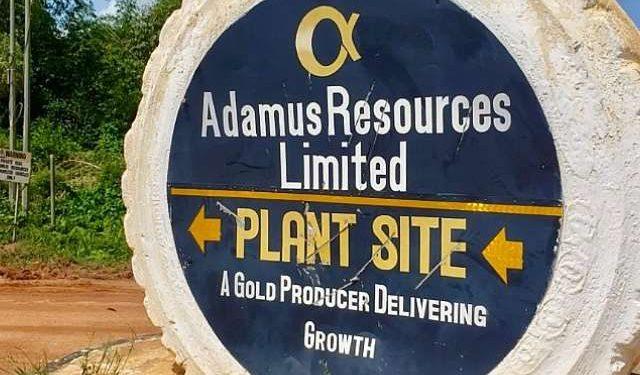
Ghana’s government has upheld the revocation of Adamus Resources’ mining lease and ordered the Minerals Commission to take immediate administrative control of the company’s mine at Salman in the Ellembelle District, marking a significant regulatory intervention in the country’s gold mining industry.
Emmanuel Armah-Kofi Buah, Minister for Lands and Natural Resources, announced the decision during a working visit to the Adamus Mine after receiving the findings of a Ministerial Review Committee established to consider an appeal by the mining company.
The committee, according to the minister, affirmed most of the breaches identified during the earlier regulatory assessment of Adamus Resources, providing the basis for the government to maintain the revocation.
“Following the report of the Minerals Commission to the Chief Inspector of Mines, and with recommendations of the great violation of the Mining Act and mining regulations. A recommendation for revocation of some mining leases was made,” Mr Buah said.
“The Ministry agreed with them; there was a petition, and we formed the ministerial review committee. That work has come to an end. As a Minister, I have concluded to uphold the revocation. What that means is that the Minerals Commission should, with immediate effect, take administrative control of this Mine.”
The intervention is economically significant because it moves the dispute beyond regulatory enforcement into the more difficult question of maintaining the productive value of a mining asset while its ownership and operating arrangements are resolved.
For Ghana, Africa’s largest gold producer, the episode is also a test of how the state balances increasingly assertive enforcement of mining regulations with the need to preserve investor confidence in a sector that remains one of the country’s most important sources of export earnings, foreign exchange, tax revenue and employment.
Mining companies typically make capital-intensive investments with long payback periods. Predictability in licensing, regulation and dispute resolution is therefore an important consideration for investors. At the same time, mining leases are conditional rights rather than unconditional ownership of mineral resources, giving the government an obligation to intervene where operators are found to have breached statutory or contractual requirements.
The minister said the review mechanism was intended to ensure Adamus Resources had an opportunity to have its objections independently considered before the government reached a final determination.
That process could prove important to the wider investment implications of the decision. A regulatory action backed by documented breaches, an appeals mechanism and transparent application of mining legislation is less likely to undermine confidence than one perceived as arbitrary.
The immediate challenge, however, is operational.
Administrative control by the Minerals Commission raises questions about how production, employment, security, environmental obligations and relationships with contractors and surrounding communities will be managed during the transition.
The government has indicated that it is exploring options to revitalise the Adamus Mine, restore production and generate employment and economic opportunities for communities within the Eastern Nzema Traditional Area.
Keeping the asset economically productive will be particularly important. A prolonged interruption to mining operations could affect workers and contractors while weakening economic activity across businesses that depend indirectly on the mine.
Mining operations generate economic effects extending beyond direct employment. Transport operators, equipment suppliers, engineering companies, food vendors, accommodation providers and other local enterprises can depend heavily on expenditure generated by large mines.
For government finances, disruption can also translate into lower royalties, corporate taxes and other fiscal receipts.
The decision therefore places considerable responsibility on the Minerals Commission. Its immediate mandate will not simply be regulatory oversight but ensuring an orderly transition that protects the physical asset, workers and surrounding communities while the government determines the mine’s longer-term operating structure.
There is also a wider policy message.
Ghana has been attempting to extract greater domestic economic value from its mineral wealth while tightening oversight of both large-scale and small-scale mining. The Adamus decision signals that government is prepared to enforce lease conditions even where intervention could temporarily affect production.
But tougher enforcement must be accompanied by regulatory consistency.
Mining investors will be watching whether the same standards are applied across operators and whether the processes leading to sanctions are transparent, predictable and consistent with Ghana’s mining legislation.
For host communities, meanwhile, the central concern is likely to be continuity. The economic benefits of stronger regulatory enforcement could be undermined if a mine remains idle for an extended period or if uncertainty results in significant job losses.
That makes the government’s proposed revitalisation strategy particularly important.
A credible transition could potentially allow the state to demonstrate that enforcement and investment are not mutually exclusive: operators must comply with Ghanaian laws while commercially viable mineral assets remain productive.
Mr Buah’s visit, accompanied by officials of the Minerals Commission and other stakeholders, was therefore as much about the future of the operation as the conclusion of the regulatory dispute.
The government says the intervention forms part of a broader effort to ensure Ghana’s mineral resources are managed in the national interest and deliver tangible benefits to citizens and host communities.
The next phase will determine whether that objective can be translated into economic results.
For the government, success will ultimately be measured not simply by the revocation of a mining lease, but by whether it can protect jobs, preserve the value of the asset, maintain regulatory credibility and return the mine to sustainable production without weakening Ghana’s attractiveness as a destination for long-term mining capital.
Written by
Liwalmor M-Moadan
M-Moadan is dedicated journalist committed to delivering accurate, timely, and impactful news. Passionate about uncovering the facts, telling meaningful stories, and keeping the public informed with integrity and professionalism.
Related Stories

Executive Director of VAST Ghana secures his second term on Movendi international Board
Mr Labram Musah Massawudu, Executive Director of Vision for Accelerated Sustainable Development Ghana (VAST Ghana), has been re-elected to the International...
Executive Director of VAST Ghana secures his second term on Movendi International Board of
Mr.Labram Musah Massawudu, Executive Director of Vision for Accelerated Sustainable Development Ghana (VAST Ghana), has been re-elected to the International...

Global South Must turn independence into Economic strength - Prof. Opoku-Agyemang
Ghana’s Vice President, Professor Jane Naana Opoku-Agyemang, has urged developing countries to focus on building stronger economies and institutions to make...
Comments (0)
No comments yet. Be the first to share your thoughts.