Ghana Treasury Bills: How They Work, Current Rates & How to Buy in Ghana

Sayibu Hamdaway
Writer/Financial Analyst
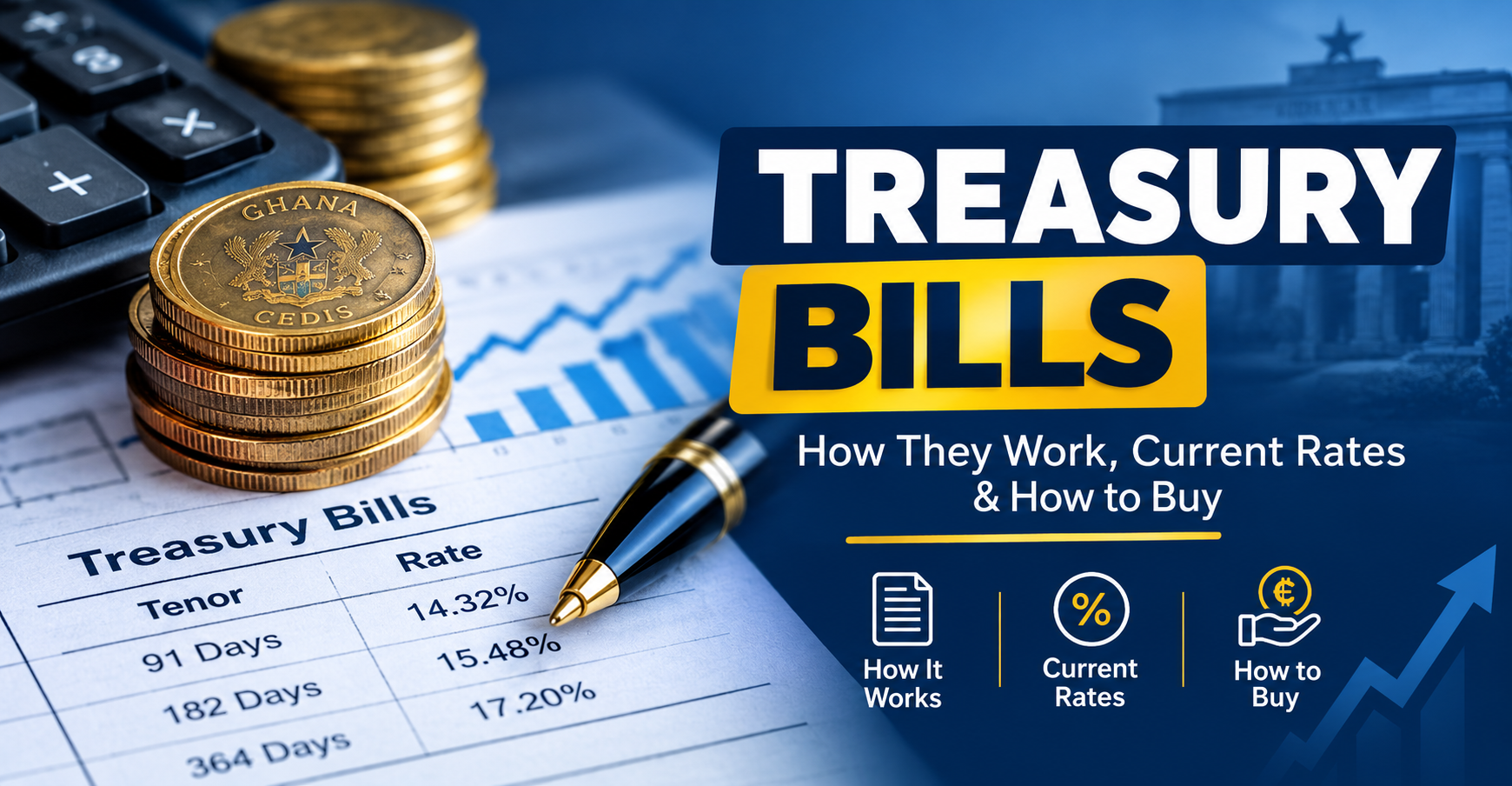
If you are looking for a relatively simple way to invest your money in Ghana while earning a return over a short period, Treasury Bills (T-Bills) are one of the investment options worth understanding.
Treasury Bills are short-term government securities issued by the Government of Ghana. They allow investors to lend money to the government for a specified period and receive the face value of the investment when the bill matures.
But how exactly do Treasury Bills work? What are the current T-Bill rates in Ghana? How much money do you need to start? And how can you buy Treasury Bills?
Here is everything you need to know.
What Are Treasury Bills?
Treasury Bills are short-term debt securities issued by the Government of Ghana. When you buy a Treasury Bill, you are effectively lending money to the government for a specific period. In return, you receive a return when the investment matures.
In Ghana, the commonly issued Treasury Bills include:
- 91-day Treasury Bill
- 182-day Treasury Bill
- 364-day Treasury Bill
The Bank of Ghana publishes the rates and auction results for Government of Ghana securities. The government currently issues the 91-day, 182-day and 364-day Treasury Bills through weekly primary auctions.
How Do Treasury Bills Work?
One important thing to understand about T-Bills is that they are generally purchased at a discount. For example, suppose a Treasury Bill has a face value of GH¢10,000. You may pay an amount below GH¢10,000 to purchase it. At maturity, you receive the full GH¢10,000. The difference between what you paid and the face value represents your return. For example, if you paid GH¢9,500 for a Treasury Bill with a face value of GH¢10,000, your gross return would be:
GH¢10,000 − GH¢9,500 = GH¢500 The exact amount you pay depends on the prevailing auction rate and the pricing of the security.
Current Treasury Bill Rates in Ghana
According to the Bank of Ghana's Treasury Bill Rates page, the latest rates available for the auction issued on 21 September 2026 were:
Treasury Bill | Discount Rate | Interest Rate 91-Day T-Bill, 4.6396% , 4.6940% 182-Day T-Bill, 6.2855% ,6.4894% 364-Day T-Bill, 9.0761% ,9.9821%
These rates are published by the Bank of Ghana and can change from one auction to another. Important: Do not assume that a rate you see today will still be available when you invest next week. Treasury Bill rates move according to market conditions and auction outcomes.
What Is the Difference Between Discount Rate and Interest Rate?
This can be confusing for new investors. The Bank of Ghana publishes both a discount rate and an interest rate for Treasury Bills.
A Treasury Bill is priced at a discount to its face value. The discount rate is used in determining the amount you pay for the security, while the interest rate represents the equivalent return on the investment. For example, the latest 364-day T-Bill had a discount rate of 9.0761% and an interest rate of 9.9821%.
Therefore, investors should pay attention to the actual amount they will pay and the amount they will receive at maturity rather than simply comparing the two percentages.
How Much Can You Make From Treasury Bills?
Your return depends on:
- The amount you invest
- The Treasury Bill tenor
- The rate available when you invest
- The purchase price
For example, if you invest in a T-Bill with a face value of GH¢10,000, the amount you pay will be below GH¢10,000 because the security is sold at a discount.
Your return is essentially the difference between your purchase price and the face value received at maturity. The longer the tenor does not automatically mean that the investment is better for every investor. You need to consider when you will need the money, the prevailing rate and your financial goals.
The Three Main Treasury Bill Options
1. 91-Day Treasury Bill
The 91-day T-Bill matures in approximately three months. It may be suitable for investors who want a relatively short investment period and expect to need their money sooner. The latest Bank of Ghana rate published for the 91-day bill was 4.6940% interest rate as of 21 September 2026.
2. 182-Day Treasury Bill
The 182-day T-Bill has a maturity period of approximately six months. It provides investors with a longer investment period than the 91-day bill. As of 21 September 2026, the published interest rate was 6.4894%.
3. 364-Day Treasury Bill
The 364-day Treasury Bill runs for approximately one year. As of 21 September 2026, the Bank of Ghana published an interest rate of 9.9821% for the 364-day bill. The 364-day bill has also attracted significant investor interest in recent months. In an August 2026 auction, it received GH¢9.94 billion in bids, accounting for nearly 70% of total bids submitted in that auction.
How to Buy Treasury Bills in Ghana
You do not need to be a large institutional investor to invest in Government of Ghana Treasury Bills. The general process is:
Step 1: Choose a bank or licensed investment dealer
You can approach a bank or an authorised securities dealer that provides access to government securities. The Bank of Ghana maintains information on authorised institutions involved in the government securities market.
Step 2: Open the required investment/securities account
If you are a new investor, your provider may require you to complete an account-opening process and provide identification and other required information.
The exact requirements can vary between institutions.
Step 3: Decide how much you want to invest
Determine how much money you can comfortably lock away for the selected period. Do not invest money that you expect to need for rent, emergencies, school fees or other immediate obligations.
Step 4: Choose your Treasury Bill tenor
You will generally choose between: 91 days → approximately 3 months 182 days → approximately 6 months 364 days → approximately 1 year Your choice should depend on your cash-flow needs and investment objectives.
Step 5: Submit your investment instruction
Your bank or investment provider will submit the necessary instruction or arrange the purchase of the Treasury Bill. The government conducts the primary auction through authorised Primary Dealers. The Bank of Ghana notes that Primary Dealers have the exclusive right to participate in the wholesale Treasury Bill auctions.
Step 6: Hold the Treasury Bill until maturity
Once your investment is completed, you receive the face value when the Treasury Bill matures, subject to the applicable terms.
Can You Sell a Treasury Bill Before Maturity?
Treasury Bills are not necessarily investments that you must hold until maturity. Government securities can also be traded in the secondary market through authorised market participants. The Ghana Fixed Income Market provides a market for government securities, while investors can access the secondary market through appropriate Depository Participants and securities dealers.
However, selling before maturity can result in a different price from what you originally paid. Therefore, investors should understand the applicable market price and transaction costs before selling.
Are Treasury Bills Risk-Free?
Treasury Bills are generally considered among the lower-risk investment instruments available to investors because they are obligations of the Government of Ghana.
However, "low risk" does not mean "no risk." Investors should consider factors such as:
- Government credit risk
- Inflation
- Changes in interest rates
- Reinvestment risk
- Liquidity requirements
- Changes in the value of money over time
For example, earning a positive nominal return does not necessarily mean your purchasing power increased if inflation is higher than your investment return.
Treasury Bills vs Savings Account
If you need immediate access to your money, keeping some funds in a liquid savings account may be more appropriate than locking everything into Treasury Bills.
Treasury Bills vs Fixed Deposits
A fixed deposit is a bank deposit where you commit your money for a specified period in exchange for an agreed return. A Treasury Bill, on the other hand, is a government security. When comparing the two, don't look only at the advertised percentage. Consider:
- Net return
- Investment period
- Liquidity
- Fees
- Tax treatment where applicable
- The institution providing the investment
- Your need for access to the money
What Happens When Your Treasury Bill Matures?
At maturity, the Treasury Bill reaches its face value. For example, if your investment has a face value of GH¢20,000, the maturity proceeds would be based on that face value under the terms of the security. You can then: Option 1: Take the money and spend it. Option 2: Reinvest it into another Treasury Bill. Option 3: Move the money into another investment.
One strategy some investors use is T-Bill laddering, where money is invested across different maturity dates rather than putting everything into one maturity.
What Is T-Bill Laddering?
T-Bill laddering involves dividing your investment across different maturities. For example, instead of putting GH¢30,000 into one Treasury Bill, an investor could structure investments around different maturity periods, depending on available products and personal cash-flow requirements.
The objective is to create more regular access to maturing funds while still earning returns on money that remains invested.
Advantages of Treasury Bills
Treasury Bills can offer several advantages:
1. Government-backed security
They are issued by the Government of Ghana.
2. Short investment periods
You can choose relatively short maturities such as 91 days.
3. Predictable maturity value
You know the face value you are scheduled to receive at maturity.
4. Accessible to individual investors
Individuals can access government securities through authorised financial institutions.
5. Useful for short-term financial planning
T-Bills can be incorporated into a broader investment and cash-management strategy.
Disadvantages of Treasury Bills
Treasury Bills also have limitations.
1. Returns can change
The rates available today may be different at the next auction.
2. Inflation can reduce real returns
If inflation rises above your investment return, your purchasing power may not increase as much as expected.
3. Your money is committed for a period
A 364-day investment may not be suitable if you need the money within a few months.
4. Reinvestment risk
When your T-Bill matures, the rate available for your next investment could be lower.
5. Selling early may affect your return
If you need to sell before maturity, the market price may differ from the amount you originally invested.
Are Treasury Bills Good for Beginners?
Treasury Bills can be one of the easier investment products for beginners to understand because the investment has a defined maturity period and the return mechanism is relatively straightforward. However, beginners should avoid putting all their money into one investment simply because it appears safe.
A basic financial plan could include:
- Emergency savings
- Treasury Bills or other fixed-income investments
- Mutual funds
- Stocks
- Business investments
- Other assets appropriate to your goals and risk tolerance
The right combination depends on your income, financial goals, time horizon and ability to handle investment risk.
Frequently Asked Questions About Ghana Treasury Bills
What is the minimum amount needed to buy Treasury Bills in Ghana?
The minimum investment can depend on the channel and provider you use. Investors should confirm the current minimum with their bank or licensed investment dealer before placing an order.
How often are Treasury Bills issued?
The Government of Ghana's 91-day, 182-day and 364-day Treasury Bills are issued through weekly primary auctions, subject to the government's issuance programme and market conditions.
Can I buy Treasury Bills with Mobile Money?
This depends on the bank, investment platform or financial institution you use. Some investment providers may allow customers to fund investments digitally, but the exact process and available payment methods vary.
Can I lose money in Treasury Bills?
Treasury Bills are generally considered lower-risk investments, but investors should not interpret that as meaning there are no risks. Inflation, liquidity needs, reinvestment risk and market conditions can all affect the overall outcome.
Which Treasury Bill has the highest rate?
The rate changes from auction to auction. As of the Bank of Ghana's 21 September 2026 published rates, the 364-day Treasury Bill had the highest interest rate at 9.9821%, compared with 6.4894% for the 182-day bill and 4.6940% for the 91-day bill.
Can I reinvest my Treasury Bill when it matures?
Yes. Once the investment matures, you can choose to reinvest the proceeds in another available Treasury Bill or use the funds for another purpose.
Final Thoughts
Treasury Bills can play an important role in a Ghanaian investor's financial plan, particularly when the objective is to preserve capital while earning a return over a defined period.
The key is to understand how T-Bills are priced, the difference between discount and interest rates, the maturity periods and the risks involved before investing. As of 21 September 2026, the Bank of Ghana's published interest rates were 4.6940% for the 91-day T-Bill, 6.4894% for the 182-day T-Bill and 9.9821% for the 364-day T-Bill. These rates can change at subsequent auctions, so investors should check the latest Bank of Ghana data before making an investment decision. For the latest official rates, investors can consult the Bank of Ghana's Treasury Bill Rates page.
Written by
Sayibu Hamdaway
Hamdaway is a Ghanaian finance educator, investor, and content creator dedicated to making investing and personal finance easy to understand. He combines financial expertise with journalism to deliver timely business, economic, and market insights. Through engaging videos, articles, and social media content, he empowers individuals to build wealth through informed financial decisions. His mission is to help people achieve financial freedom by transforming complex financial concepts into practical, actionable knowledge.
Related Stories
10 Profitable Small Businesses You Can Start in Ghana With GHS 1,000
Starting a business in Ghana does not always require thousands of cedis in capital. With GHS 1,000, you can start a small business, test your idea, build a...

Hamdaway Explained How You Can Invest
Saving Is the Slowest Way to Go Broke
Everyone tells you to save. Nobody tells you what saving actually costs. Put $10,000 in a savings account earning 1% a year. In ten years, you'll have roughly...
Comments (0)
No comments yet. Be the first to share your thoughts.