Mahama says reparations debate must focus on institutions that profited from slavery
Liwalmor M-Moadan
Journalist
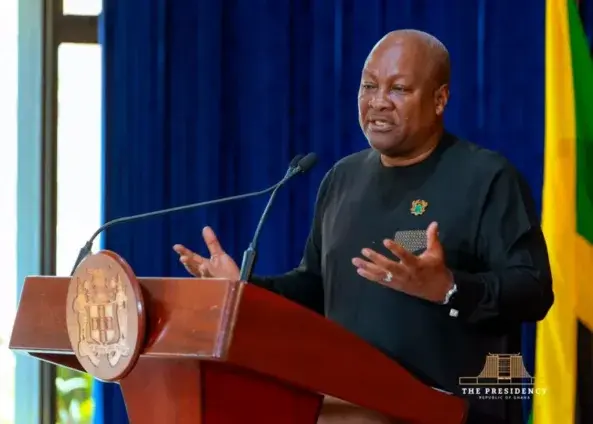
President John Dramani Mahama has dismissed arguments that the participation of some Africans in the transatlantic slave trade weakens the moral or legal case for reparations, insisting that responsibility ultimately rests with the governments, institutions and commercial systems that conceived, financed and sustained one of history’s largest forced migration networks.
Speaking during a high-level dialogue on reparations at the University of the West Indies in Jamaica as part of his state visit, Mahama argued that the existence of African intermediaries neither diminishes the scale of the atrocity nor absolves those who designed and institutionalised the transatlantic slave trade.
His intervention comes at a time when the global reparations movement is gaining renewed momentum, with African and Caribbean leaders seeking greater international recognition of slavery’s enduring economic and social consequences. The issue has increasingly moved beyond symbolic apologies toward debates over financial compensation, institutional accountability, debt relief and development partnerships.
Drawing a comparison with the Holocaust, Mahama argued that collaboration by individuals within victimised communities has never been accepted as a justification for denying crimes against humanity.
“The Holocaust occurred, and I believe that there was a Holocaust and six million Jews were killed. Some of the most brutal prison guards were Jews. Some of those who went into the communities and showed where Jews were hiding and delivered them to the Nazis to be exterminated were Jews.
“But it doesn’t mean the Holocaust didn’t happen and that the Holocaust wasn’t a crime against humanity.”
Applying the same reasoning to the transatlantic slave trade, Mahama rejected attempts to shift historical responsibility onto Africans who acted as intermediaries within a much larger international commercial system.
“So even the argument that Africans were involved in enslaving Africans does not stop it from being the gravest crime against humanity.”
The president argued that the reparations debate should focus not only on those who captured enslaved Africans but also on the extensive legal, financial and commercial infrastructure that transformed human trafficking into one of the world’s most profitable economic enterprises for centuries.
“You must look at all the legal underpinnings. You must look at everything that was established to support the slave trade in terms of the insurance of the cargo, the auctions, and all that.”
His remarks highlighted a growing strand of reparations scholarship that examines how European governments, banks, insurers, shipping companies and commercial institutions accumulated wealth through slavery—wealth that many campaigners argue continues to influence global patterns of inequality today.
Mahama described the transatlantic slave trade as a highly organised international system rather than a series of isolated transactions involving local actors.
“It was a very systematic trade, and so you cannot wish it away just by saying that some agents whom you use as agents to bring you slaves as commodities participated in it, and because they were Africans, then it means that the slave trade didn’t happen.
“No, we reject that.”
Beyond the reparations debate, the Ghanaian president also challenged how slavery has historically been taught in African schools, arguing that colonial-era education often placed greater emphasis on abolitionists than on the brutality experienced by millions of enslaved Africans.
Mahama said independent African nations now have both the responsibility and the freedom to present a fuller historical account to younger generations.
“We are now independent. We should be able to tell our children the truth.”
Reflecting on his own education, he recalled that classroom instruction largely celebrated the campaign to abolish slavery while giving comparatively little attention to the scale of human suffering that preceded abolition.
“When I was growing up in primary school, the abolitionists were put as the most important thing that happened in the slave trade.
“We were taught about the slave trade. The gravity of what happened in the slave trade was never really spelled out. It was the bravery of the abolitionists and how they were the knights in shiny armour who came and stopped it and saved Africans.”
While acknowledging the important contribution of abolitionists, Mahama argued that historical narratives should equally recognise the experiences of enslaved Africans and the lasting effects of slavery on African societies and the global African diaspora.
“So all these people who were involved in the abolition movement were lionised in our history books. Now we can begin to tell our children the truth.”
The president also welcomed renewed international engagement with the reparations agenda, noting that recent discussions at the United Nations had stimulated broader public interest in understanding the transatlantic slave trade and its enduring legacy.
“I think that since the resolution was passed on the General Assembly, it’s piqued interest in trying to understand and know what exactly happened.”
Mahama expressed optimism that deeper historical awareness would strengthen both Africa’s understanding of its past and its ability to shape future development.
“I believe that awareness is being created. People are aware of what happened. And it helps for you to know where we have come from, because that informs where we are going.”
His remarks reinforce Ghana’s increasingly prominent role in the global reparations movement, aligning the country with broader African Union and Caribbean Community (CARICOM) efforts to frame slavery not merely as a historical injustice but as a systemic crime whose economic and developmental consequences continue to shape inequalities across continents. By placing responsibility on the institutional architecture that sustained slavery rather than on individual collaborators, Mahama sought to strengthen the legal and moral foundation of the modern reparations campaign while calling for a more complete telling of Africa’s history.
Written by
Liwalmor M-Moadan
M-Moadan is dedicated journalist committed to delivering accurate, timely, and impactful news. Passionate about uncovering the facts, telling meaningful stories, and keeping the public informed with integrity and professionalism.
Related Stories

Accra and Kumasi Expressway: Government Targets Full Funding by End of 2026 as Military Clears 170km Corridor
Ghana’s ambitious Accra and Kumasi Expressway project has moved closer to its construction phase, with the government announcing that it expects to secure the...
Ghana Immigration clears beggars from the streets of Accra and Kumasi
1,055 beggars remove from the street of Accra and Kumasi, Ghana Immigration Service migrant as part of an operation targeting undocumented foreign nationals....
Star Oil cuts petrol below GH¢15 as Ghana fuel retailers begin August price reset
Some Oil Marketing Companies (OMCs) began reviewing petroleum product prices on Monday, August 17, with Star Oil emerging as one of the first large retailers...
Comments (0)
No comments yet. Be the first to share your thoughts.