Mobile Money Deepens Digital Credit Push as Trust and Cybersecurity Shape Ghana’s Fintech Growth

Sayibu Hamdaway
Writer/Financial Analyst
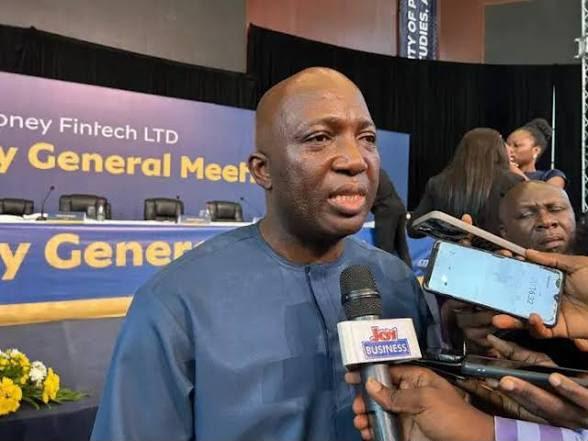
Mobile Money Fintech Limited is expanding deeper into digital lending and broader financial services as Ghana’s mobile money industry evolves beyond payments, but chief executive Shaibu Haruna says the next phase of growth will depend increasingly on responsible borrowing, cybersecurity and the ability of operators to preserve customer trust.
The strategy signals a significant evolution in Ghana’s fintech market. Mobile wallets, initially built around person-to-person transfers, cash deposits and withdrawals and airtime purchases, are becoming platforms through which consumers and businesses can access credit and an expanding range of financial products.
Speaking at MTN Ghana’s “Facts Behind the Figures” engagement with the Ghana Stock Exchange in Accra on August 10, Mr Haruna said product innovation had become central to increasing the usefulness of the Mobile Money platform.
“A big piece of it is also around the product innovation that we brought in. We’ve brought in quite a number of loan services, and we’ve run some responsible borrowing campaigns to also get customers in the habit of, you know, taking loans and, of course, paying them on time and benefiting from a lot more services that we have on the platform,” he said.
The push towards credit represents an important commercial opportunity for Mobile Money, but also raises more complicated questions around consumer indebtedness, credit quality and financial stability as borrowing becomes easier and faster.
From payments to financial intermediation
The economics of mobile money are changing.
Payments provided the infrastructure and customer base that allowed mobile wallets to scale rapidly. But lending potentially allows fintech companies to extract greater economic value from that infrastructure by turning transaction platforms into broader financial-services ecosystems.
For consumers and small businesses, particularly those with limited access to traditional banks, digital lending can provide financing without many of the collateral, paperwork and physical branch requirements associated with conventional credit.
The opportunity could be especially significant for Ghana’s informal and micro-enterprise economy.
Small businesses frequently struggle to obtain bank credit because they lack audited accounts, conventional collateral or extensive credit histories. Yet increasingly digital transactions can provide alternative information about cash flows and financial behavior.
For fintech operators, those transaction histories can potentially improve credit assessment and allow loans to be extended to customers previously considered difficult or expensive to serve.
That makes digital credit potentially important to Ghana’s broader financial-inclusion agenda.
But lowering the barriers to borrowing also lowers the barriers to excessive borrowing.
Responsible lending becomes economic necessity
The speed and convenience of digital credit can encourage repeated borrowing, particularly where customers use short-term loans to finance persistent expenditure rather than temporary liquidity gaps.
For Mobile Money, responsible borrowing is therefore not merely a consumer-protection issue. It is fundamental to the economics of the lending business.
Loan growth can generate higher revenue, but that expansion becomes financially destructive if repayment rates deteriorate and credit losses rise.
Mobile Money's campaign to encourage customers to repay loans on time suggests the company recognizes that sustainable digital lending depends as much on repayment discipline as on customer acquisition.
Strong repayment behavior could eventually allow lenders to differentiate between borrowers, potentially enabling customers with better records to obtain larger loans, longer repayment periods or additional financial products.
That would move mobile money further towards the territory traditionally occupied by banks.
Yet the expansion of digital financial services creates another challenge: the more money and financial activity that move through mobile platforms, the more valuable those systems become to criminals.
Trust becomes a financial asset
Mr. Haruna said cybersecurity had therefore become fundamental to Mobile Money's strategy.
“For us, it’s a very important piece because the very foundation of the service offering that we have is based on trust,” he said.
“Customers, for every transaction that a customer does, there is an underlying expectation that that transaction will be successful. And for us, we invest in ensuring that that happens.”
Trust has unusually direct economic value in financial services.
A consumer may tolerate temporary inconvenience from an entertainment or retail platform. The threshold is considerably lower when personal money is involved.
Customers expect transactions to be accurate, immediate and secure. Any perception that funds could disappear or accounts could be compromised risks changing behavior rapidly.
That means the financial cost of fraud can extend far beyond the value stolen in an individual incident.
Repeated fraud could reduce transaction frequency, discourage customers from keeping balances in their wallets and make them reluctant to adopt more sophisticated products such as loans, savings, insurance or investment services.
Mobile Money is consequently treating cybersecurity spending increasingly as core financial infrastructure.
“So foundationally, we make sure that we have the best-in-class technology and cybersecurity elements built onto our platform, and we continuously invest in that piece,” Mr Haruna said.
Cybersecurity becomes a cost of growth
The economics of security are becoming more important as Ghana’s digital-finance ecosystem expands.
Every additional transaction, customer and financial product increases the amount of economic activity dependent on digital infrastructure.
For fintech operators, cybersecurity can therefore no longer be regarded principally as an information-technology expense. It increasingly represents an investment necessary to protect revenues, customer retention and the integrity of the wider platform.
Yet technology alone cannot eliminate fraud.
Mr Haruna acknowledged that some of the most persistent vulnerabilities come from customers themselves, particularly through social engineering, where criminals manipulate individuals into disclosing sensitive information or approving fraudulent transactions.
“A lot of the incidents that we see happening around us is around, you know, customer vulnerabilities from, you know, unfortunately, from, you know, social engineering,” he said.
The problem illustrates a fundamental weakness in digital finance: operators can invest heavily in securing their systems while criminals bypass those defenses by targeting the individual using them.
Mobile Money is consequently combining technology investment with customer education.
“We are also anchoring that not just through the media, but also going on ground into the communities to engage customers on the need for them to safeguard their wallets. And we’ll continue to invest in that regard,” Mr Haruna said.
The company is also investing in technology intended to identify and prevent suspicious activity before fraudulent transactions are completed.
But Mr. Haruna said those systems would still need to be complemented by more informed customers.
“Whatever we invest in in terms of technology, it has to be supported by customer awareness about the risk and also what they have to do to safeguard the environment,” he said.
The next frontier
The combination of credit expansion and greater cybersecurity investment captures the central challenge confronting Ghana’s rapidly developing fintech industry.
Digital lending offers operators an opportunity to diversify revenue while extending finance to consumers and businesses that may remain underserved by conventional banks.
But the same expansion increases credit risk, cybersecurity exposure and the consequences of any breakdown in customer confidence.
For Mobile Money, the strategic objective is therefore becoming more complex.
The company must persuade customers to borrow while encouraging them not to borrow irresponsibly; increase the number and value of transactions while making those transactions more secure; and expand the range of financial products without weakening the trust that allowed mobile money to become deeply embedded in Ghana’s economy.
If those tensions can be managed, mobile money could develop from primarily a payments infrastructure into one of Ghana’s most important channels for distributing credit and other financial services.
But the next stage of fintech competition may ultimately be decided by something less visible than transaction volumes or product launches.
As digital wallets assume a larger role in savings, borrowing and everyday commerce, customer confidence becomes an economic asset in its own right.
For Mobile Money, innovation may determine how quickly the platform expands. Responsible credit and cybersecurity will determine whether that expansion lasts.
Written by
Sayibu Hamdaway
Hamdaway is a Ghanaian finance educator, investor, and content creator dedicated to making investing and personal finance easy to understand. He combines financial expertise with journalism to deliver timely business, economic, and market insights. Through engaging videos, articles, and social media content, he empowers individuals to build wealth through informed financial decisions. His mission is to help people achieve financial freedom by transforming complex financial concepts into practical, actionable knowledge.
Related Stories

Ghana’s Gold Revolution: Can Refining Gold at Home Finally Keep More of the Country’s Wealth in Ghana?
For generations, Ghana has drawn enormous wealth from beneath its soil, yet much of the value created from that wealth has flowed beyond its borders. Now,...
GoldBod Targets $1.4bn as BoG Reduces September Dollar Sales
The Bank of Ghana (BoG) has sharply reduced the amount of foreign exchange it plans to supply to the market in September 2026. Market data indicate that the...
Four CIIG Awards Strengthen Enterprise Insurance’s Leadership Position
Enterprise Insurance emerged as the most successful company at the sixth Chartered Insurance Institute of Ghana (CIIG) Awards, securing four major honours at...
Comments (0)
No comments yet. Be the first to share your thoughts.