MTN Ghana Pivots to Fiber and AI as 19.3GB Data Appetite Reshapes Telecoms Economics

Sayibu Hamdaway
Writer/Financial Analyst
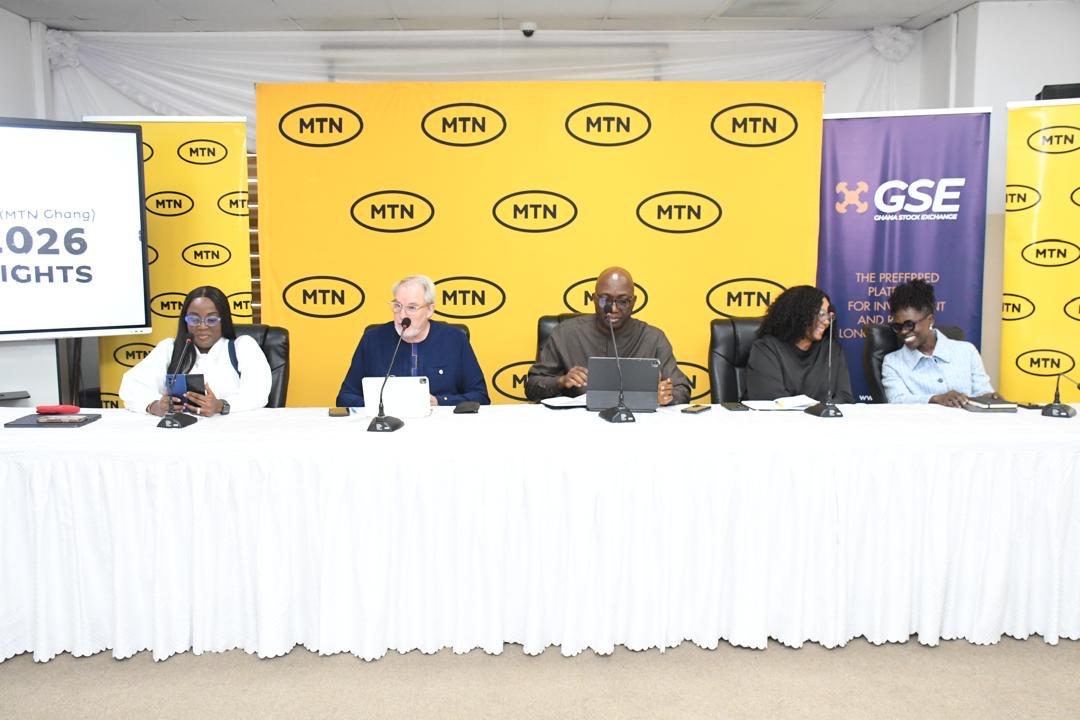
MTN Ghana is accelerating investment in fiber infrastructure and artificial intelligence-powered network management as rapidly rising data consumption transforms the economics of Ghana’s telecommunications market, shifting the industry further away from its traditional dependence on voice revenues.
Customers on MTN Ghana’s network now consume an average of 19.3 gigabytes of data each month, highlighting a structural change in consumer behavior that is forcing the country’s largest telecoms operator to invest more heavily in network capacity while searching for new ways to monetize connectivity.
Stephen Blewett, chief executive officer of MTN Ghana, said the company’s strategy would increasingly revolve around improving the quality of customers’ data experience through fiber deployment, broader mobile coverage and greater use of artificial intelligence.
Speaking at MTN Ghana’s “Facts Behind the Figures” engagement at the Ghana Stock Exchange in Accra, Mr Blewett said network quality had become one of the most important considerations for customers.
“I think in terms of data, our focus is how do we give people the best possible experience? Because that’s the number one question I get from people — how do I get the best experience?” he said.
“So we’re investing heavily in fiber. We dropped the price of fiber, as you know, so we’re giving people more access to fiber.”
The strategy reflects a deeper transformation underway across Ghana’s telecommunications industry.
Data is no longer an ancillary product sold alongside voice and text messaging. It is becoming the principal infrastructure through which consumers communicate, businesses sell products, financial institutions reach customers and digital platforms deliver services.
For MTN, that transition creates a significant growth opportunity but also a costly infrastructure challenge.
Fiber becomes an economic asset
Fiber is central to MTN’s response because it can support substantially heavier consumption while delivering more reliable fixed broadband connections.
“Why fiber? Because it gives you a very rich experience with high data usage. You’re always going to have that with fiber,” Mr Blewett said.
Reducing fiber prices could broaden the addressable market beyond large companies and affluent households, potentially expanding high-speed broadband access to smaller businesses and middle-income consumers.
The economic implications extend beyond MTN’s balance sheet.
Reliable broadband has become an increasingly important input into productivity. Ghanaian businesses are using connectivity for payments, banking, cloud services, inventory management, advertising, customer acquisition and communication.
As these activities migrate online, the quality and cost of broadband increasingly influence the competitiveness of companies, particularly small and medium-sized enterprises.
Mr Blewett said Ghana’s rising data consumption was not simply the result of consumers watching more videos or spending additional time on entertainment platforms.
“People in Ghana are using an average 19.3 gigabytes per month. So it means there’s an appetite for this,” he said.
“And people are not only using it for entertainment, they’re using it for business, etc. So we’re going to support people to grow that.”
AI meets the capacity challenge
But higher consumption comes with a price.
As average data usage increases, MTN must continually expand network capacity to prevent congestion and maintain service quality. That means more investment in fiber, mobile infrastructure, spectrum and supporting technology.
Artificial intelligence is increasingly being deployed to improve the economics of that investment.
“When it comes to the rest of mobile data, [it is about] giving more coverage and improving our network, using AI to ensure that we look after our network in a way that gives people the best possible experience,” Mr.Blewett said.
AI-powered network management can potentially analyze traffic patterns, predict congestion, identify faults and help determine where additional capacity is required.
For a capital-intensive operator, the financial attraction is straightforward: better network utilization can allow MTN to accommodate more traffic without requiring investment to increase at exactly the same pace as data consumption.

Voice decline signals structural change
MTN Ghana’s financial performance provides evidence of how quickly the market is evolving.
Voice revenue declined 1.4 per cent year-on-year to GH¢1.9bn during the first half of 2026.
The decline reflects a broader migration from conventional telephone calls towards internet-based applications such as WhatsApp, which convert communication that previously generated voice revenue into data traffic.
Yet customer engagement remains strong.
MTN Ghana’s subscriber base increased 8.5 per cent to 32.8mn, suggesting consumers are not abandoning telecommunications services. Instead, they are changing how they use them.
Digital services revenue surged 98 per cent to GH¢377mn, supported by gaming, video and other digital-content products.
The contrast between declining voice revenue and rapidly expanding digital services captures the fundamental strategic challenge facing telecom operators: replacing mature revenue streams with businesses capable of monetizing the enormous volumes of data flowing through their networks.
Mobile Money provides another engine
Mobile Money has emerged as perhaps the clearest example of MTN successfully building a business on top of its telecommunications infrastructure.
Revenue increased 23.3 per cent to GH¢3.5bn, while active users reached 18.3mn. Transaction volumes rose 23.3 per cent and transaction values expanded 44.4 per cent.
“The continued expansion of our fintech ecosystem, together with the successful structural separation completed in the first quarter, positions the business well to capture future opportunities arising from increasing financial inclusion and the digitization of payments across the market,” Mr Blewett said.
The combination of connectivity and financial services gives MTN a powerful position within Ghana’s emerging digital economy.
Its telecommunications infrastructure provides access, smartphones provide the interface, data connects consumers to services and Mobile Money allows them to transact.
That increasingly makes the economic value of an MTN subscriber dependent not merely on the number of calls made, but on data consumption, digital-service usage and financial transactions.
Affordability versus investment
MTN must nevertheless navigate a delicate economic balance.
Lower fiber prices could stimulate adoption and increase consumption, but network expansion requires substantial capital expenditure.
Telecommunications equipment is also heavily import-dependent, leaving investment costs exposed to exchange-rate movements and global equipment prices.
At the same time, a customer consuming 19.3GB a month places significantly greater demands on infrastructure than one consuming a fraction of that amount several years ago.
That creates an unusual dynamic: success in stimulating demand can itself create pressure for additional capital expenditure.
Artificial intelligence can improve network efficiency, but it cannot eliminate the need for physical infrastructure. Fiber still needs to be deployed, mobile capacity expanded and networks upgraded as traffic increases.
The strategic trajectory is nevertheless clear.
Ghana’s telecommunications industry is moving beyond an era in which subscriber numbers and voice minutes were the dominant measures of performance.
Connectivity is becoming an essential piece of national economic infrastructure, supporting commerce, financial services, education, entertainment and increasingly the everyday operations of businesses.
For MTN Ghana, the next phase of growth will therefore depend less on how many people it can connect than on how much economic activity those connections can support and whether investment in fiber, mobile capacity and AI can keep pace with a customer base whose appetite for data is expanding faster than the traditional voice business it is replacing.
Written by
Sayibu Hamdaway
Hamdaway is a Ghanaian finance educator, investor, and content creator dedicated to making investing and personal finance easy to understand. He combines financial expertise with journalism to deliver timely business, economic, and market insights. Through engaging videos, articles, and social media content, he empowers individuals to build wealth through informed financial decisions. His mission is to help people achieve financial freedom by transforming complex financial concepts into practical, actionable knowledge.
Related Stories

Ghana’s Gold Revolution: Can Refining Gold at Home Finally Keep More of the Country’s Wealth in Ghana?
For generations, Ghana has drawn enormous wealth from beneath its soil, yet much of the value created from that wealth has flowed beyond its borders. Now,...
GoldBod Targets $1.4bn as BoG Reduces September Dollar Sales
The Bank of Ghana (BoG) has sharply reduced the amount of foreign exchange it plans to supply to the market in September 2026. Market data indicate that the...
Four CIIG Awards Strengthen Enterprise Insurance’s Leadership Position
Enterprise Insurance emerged as the most successful company at the sixth Chartered Insurance Institute of Ghana (CIIG) Awards, securing four major honours at...
Comments (0)
No comments yet. Be the first to share your thoughts.