UAE extends US$1mn flood relief to Ghana as climate shocks expose resilience financing gap
Liwalmor M-Moadan
Journalist
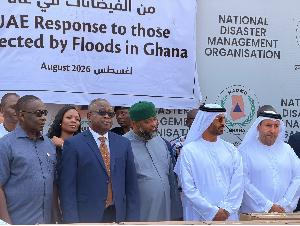
The United Arab Emirates has donated relief items valued at US$1 million to Ghana to support communities affected by devastating floods, providing an important humanitarian lifeline while bringing renewed attention to the growing economic cost of climate-related disasters and the country’s capacity to finance resilience.
The assistance was received on behalf of the Government of Ghana by Seidu Issifu, Minister of State for Climate Change and Sustainability, as authorities intensify efforts to support households and communities affected by the floods.
The donation represents another strand of Ghana’s expanding diplomatic and development relationship with the UAE, but its significance extends beyond the immediate value of the humanitarian supplies.
For Ghana, where floods routinely destroy homes, disrupt businesses, damage roads and other public infrastructure and displace households, climate-related disasters are increasingly becoming a fiscal and economic problem rather than simply a humanitarian emergency.
Receiving the items, Mr Issifu expressed the government’s appreciation to the UAE for supporting Ghana during the emergency.
“The Government of Ghana is grateful to the Government and people of the United Arab Emirates for this timely support,” he said.
The assistance is expected to strengthen relief efforts for affected communities, complementing interventions by state agencies responsible for emergency response and disaster management.
But the latest flooding also underscores a deeper policy challenge confronting Ghana: how to move from repeatedly financing emergency responses towards building infrastructure and institutions capable of reducing the economic damage caused by extreme weather.
Climate shocks carry mounting economic costs
Flooding has long been a recurring feature of Ghana’s rainy season, particularly in urban centres and low-lying communities.
Yet the economic consequences are becoming increasingly difficult to ignore.
When flooding destroys roads, bridges, schools and health facilities, government faces reconstruction costs that were often not anticipated in annual budgets. When shops, farms and small businesses are affected, household incomes and private-sector productivity are also disrupted.
For a country emerging from a severe sovereign debt crisis, such unexpected expenditure represents an additional fiscal risk.
Ghana’s public finances have undergone extensive adjustment following its 2022 debt default and subsequent domestic and external debt restructuring. Government consequently has less room to absorb large unplanned expenditures without either reallocating resources from other priorities or increasing borrowing requirements.
Humanitarian assistance such as the UAE’s US$1 million contribution therefore provides more than emergency supplies. It effectively transfers part of the immediate financial burden of disaster response away from Ghana’s constrained public balance sheet.
However, foreign assistance cannot provide a permanent solution to a structural climate vulnerability.
The more difficult question is whether Ghana can mobilise sufficient capital for flood prevention, drainage infrastructure, resilient roads, early-warning systems and improved urban planning before disasters occur.
Prevention versus reconstruction
The economics increasingly favour prevention.
Infrastructure capable of withstanding climate shocks typically requires greater upfront investment, but the long-term cost can be considerably lower than repeatedly rebuilding damaged assets.
Ghana’s rapid urbanisation makes that calculation particularly important.
Expansion of settlements, inadequate drainage networks, construction along waterways and weak enforcement of planning regulations have increased the exposure of some communities to flooding.
Heavy rainfall can therefore quickly become an economic shock.
Blocked drains and inadequate stormwater infrastructure can cause commercial districts to become inaccessible, disrupt transportation and destroy inventory belonging to traders and small businesses.
Agricultural communities face different but equally significant risks. Flooding can destroy crops, damage irrigation infrastructure and interrupt transportation between farming communities and major markets.
That can ultimately affect food supply and prices.
The consequences therefore extend from individual households to inflation, government expenditure, employment and economic output.
Climate change could amplify those vulnerabilities.
More unpredictable rainfall patterns and increasingly extreme weather events mean infrastructure designed using historical assumptions may no longer provide adequate protection.
For policymakers, climate resilience must consequently become part of mainstream economic planning rather than a separate environmental policy issue.
Opportunity for deeper Ghana-UAE climate partnership
The UAE’s intervention also raises the prospect of a broader relationship around climate investment.
The Gulf state has become an increasingly significant source of capital across Africa, with investment interests ranging from renewable energy and logistics to infrastructure, technology and agriculture.
For Ghana, that creates an opportunity to shift part of the bilateral relationship from emergency humanitarian assistance towards long-term climate financing.
Investment in stormwater infrastructure, renewable energy, climate-smart agriculture, coastal protection and disaster-monitoring technology could generate economic benefits extending well beyond disaster management.
Early-warning systems, for example, could allow communities to evacuate vulnerable areas before floods become severe, while better meteorological information could help farmers make more informed planting decisions.
Improved drainage infrastructure in major commercial centres could reduce business interruptions and protect public and private assets.
Such investments would also complement Ghana’s broader attempt to attract private capital into infrastructure as government borrowing remains constrained.
Climate resilience becomes fiscal policy
The larger lesson from the latest disaster is that climate resilience and fiscal sustainability are increasingly interconnected.
Every road reconstructed after flooding represents capital that could have been invested elsewhere. Every emergency allocation for displaced households places additional pressure on government expenditure. Every business forced to close temporarily represents lost economic activity and, potentially, lost tax revenue.
The costs are dispersed across the economy, making them less visible than conventional government expenditure but no less significant.
Ghana therefore faces a choice between continuing to absorb those losses after disasters occur or investing more aggressively in reducing its vulnerability beforehand.
The UAE’s US$1 million donation provides immediate assistance to communities confronting the consequences of the latest floods and reflects strengthening relations between Accra and Abu Dhabi.
But it also illustrates the limits of emergency assistance.
For Ghana, the long-term economic challenge will be turning climate resilience into a central component of infrastructure and fiscal planning — ensuring that international support is increasingly directed not only towards helping communities recover from disasters, but towards preventing extreme weather from becoming an economic disaster in the first place.
Written by
Liwalmor M-Moadan
M-Moadan is dedicated journalist committed to delivering accurate, timely, and impactful news. Passionate about uncovering the facts, telling meaningful stories, and keeping the public informed with integrity and professionalism.
Related Stories

Ghana’s Gold Revolution: Can Refining Gold at Home Finally Keep More of the Country’s Wealth in Ghana?
For generations, Ghana has drawn enormous wealth from beneath its soil, yet much of the value created from that wealth has flowed beyond its borders. Now,...
GoldBod Targets $1.4bn as BoG Reduces September Dollar Sales
The Bank of Ghana (BoG) has sharply reduced the amount of foreign exchange it plans to supply to the market in September 2026. Market data indicate that the...
Four CIIG Awards Strengthen Enterprise Insurance’s Leadership Position
Enterprise Insurance emerged as the most successful company at the sixth Chartered Insurance Institute of Ghana (CIIG) Awards, securing four major honours at...
Comments (0)
No comments yet. Be the first to share your thoughts.