Ofankor Crash Leaves 11 Dead as Ghana’s Road Safety Crisis Deepens
Liwalmor M-Moadan
Journalist
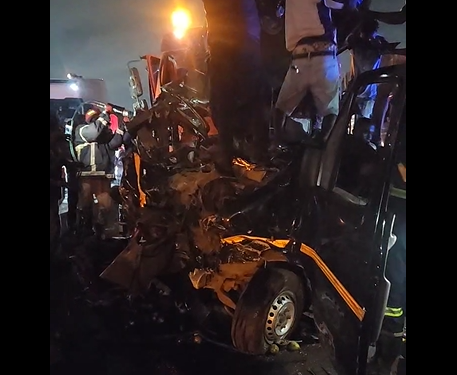
A deadly collision on one of Ghana’s busiest transport corridors has renewed scrutiny of the country’s road safety architecture, after at least 11 people were killed in an accident at Ofankor Barrier on the Accra–Kumasi Highway on Thursday morning.
The crash, which occurred in the early hours of August 13, involved a tipper truck and a Mercedes-Benz Sprinter bus, leaving the passenger vehicle severely mangled and several occupants trapped in the wreckage.
Several other people sustained severe injuries and were transported to various medical facilities for treatment as emergency services raced to rescue passengers trapped following the impact.
Emergency personnel from the Ghana National Fire Service were dispatched to the scene, where rescuers worked through the wreckage to extricate passengers and provide immediate assistance to survivors.
According to ADO1 Alex King Nartey of the Ghana National Fire Service (GNFS), rescue teams worked to free victims trapped in the mangled vehicle and transport those with serious injuries to medical facilities.
Among those evacuated was a female victim whose legs were reportedly severed in the collision, underscoring the severity of the impact.
The accident also disrupted traffic along the highway, forcing authorities to temporarily restrict a section of the road while emergency personnel conducted rescue operations and cleared the wreckage.
Investigations are expected to establish the circumstances that triggered the collision, including the movements of the vehicles immediately before impact and whether speed, mechanical failure, driver behaviour or other factors played a role.
Beyond the immediate tragedy, however, the Ofankor crash is likely to intensify debate about the effectiveness of Ghana’s road safety policies at a time when fatalities have emerged as a persistent public-health and economic challenge.
The country continues to record thousands of road crashes annually, resulting in significant numbers of deaths and injuries. The persistence of serious accidents, particularly on major highways and heavily travelled urban corridors, has increased pressure on policymakers to move beyond periodic road safety campaigns towards interventions that address the structural causes of crashes.
The Ofankor tragedy is therefore more than an isolated transport accident. It highlights the interaction between commercial transport, heavy-duty vehicles, road design, driver behaviour, enforcement and emergency response along corridors carrying large volumes of passengers and freight.
The Accra–Kumasi Highway is particularly economically significant because it connects the capital with Ghana’s second-largest commercial centre and serves as an artery for the movement of goods and passengers towards the middle and northern parts of the country.
Serious crashes on such corridors consequently carry costs that extend well beyond the immediate casualties.
Deaths and disabling injuries remove workers from the labour force, reduce household income, create long-term healthcare expenses and place additional pressure on emergency medical services. Businesses can also face delays when accidents block strategic transport routes, disrupting logistics and increasing the cost and uncertainty associated with moving goods.
For households, the financial consequences can be particularly severe when victims are primary income earners.
A fatal accident can abruptly eliminate a family’s main source of income, while serious injuries can create prolonged medical and rehabilitation expenses. Where victims require long-term care, other members of the household may also be forced to reduce their economic activity to provide support.
That makes road safety not merely a transport policy issue but increasingly an economic-development challenge.
The persistence of fatalities despite public education campaigns also raises questions about whether Ghana’s approach needs to shift more aggressively from behavioural messaging towards systemic risk reduction.
Enforcement of speed limits, vehicle roadworthiness requirements and commercial-driver regulations remains essential. But infrastructure design, pedestrian protection, lighting, safer junctions, restrictions on inappropriate stopping and loading, and stronger monitoring of heavy-duty and passenger vehicles can be equally important.
The Ofankor area itself forms part of a busy urban transport corridor where commercial vehicles, private cars, pedestrians and heavy trucks compete for limited road space. Such environments can amplify the consequences of driver error or excessive speed, particularly during periods when traffic is moving relatively freely.
The presence of commercial passenger vehicles also increases the potential casualty count from individual collisions. A crash involving a fully occupied Sprinter bus, for instance, can transform a single traffic incident into a mass-casualty emergency within seconds.
That places additional emphasis on commercial transport regulation.
Authorities face the challenge of ensuring that vehicles are mechanically fit, drivers comply with speed and rest requirements, and passenger-loading practices do not create additional hazards along major roads.
Emergency response is another critical part of the equation.
The work of the Ghana National Fire Service and ambulance personnel following the Ofankor collision demonstrates the importance of rapid rescue capabilities, particularly where victims become trapped inside badly damaged vehicles.
But emergency response can only mitigate the consequences of a crash. The more difficult policy objective is preventing the collision from occurring in the first place.
That requires coordination between road agencies, the police, transport operators, local authorities, emergency services and road safety regulators.
Ghana has already recognised the urgency of the problem through road safety strategies and repeated enforcement and education campaigns. Yet the continuing loss of life indicates that implementation remains the decisive test.
Thursday’s accident provides another painful reminder of the stakes.
For the families of the 11 people confirmed dead, the statistics translate into irreversible personal loss. For policymakers, the collision adds urgency to a broader question confronting Ghana’s transport system: whether road safety can move from periodic campaigns and post-crash responses towards a sustained framework capable of preventing fatal collisions before they occur.
As emergency crews clear the wreckage at Ofankor and investigators establish what caused the crash, the larger policy challenge remains — ensuring that one of the country’s most important transport corridors does not continue to exact an unacceptable human and economic toll.
Written by
Liwalmor M-Moadan
M-Moadan is dedicated journalist committed to delivering accurate, timely, and impactful news. Passionate about uncovering the facts, telling meaningful stories, and keeping the public informed with integrity and professionalism.
Related Stories

Executive Director of VAST Ghana secures his second term on Movendi international Board
Mr Labram Musah Massawudu, Executive Director of Vision for Accelerated Sustainable Development Ghana (VAST Ghana), has been re-elected to the International...
Executive Director of VAST Ghana secures his second term on Movendi International Board of
Mr.Labram Musah Massawudu, Executive Director of Vision for Accelerated Sustainable Development Ghana (VAST Ghana), has been re-elected to the International...

Global South Must turn independence into Economic strength - Prof. Opoku-Agyemang
Ghana’s Vice President, Professor Jane Naana Opoku-Agyemang, has urged developing countries to focus on building stronger economies and institutions to make...
Comments (0)
No comments yet. Be the first to share your thoughts.