Trump Expands U.S. Trade Barrier, Slaps 12.5% Tariff on Nigeria, South Africa and Dozens of Other Economies
Liwalmor M-Moadan
Journalist
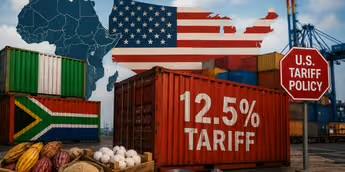
The United States has imposed a fresh wave of import tariffs on 60 trading partners, placing Nigeria, South Africa and several of Africa’s largest exporting economies under a new 12.5% duty as President Donald Trump broadens his protectionist trade agenda through Section 301 of the Trade Act of 1974.
The measures, announced by the White House and implemented by the Office of the U.S. Trade Representative (USTR), target countries Washington says have failed to adequately prohibit or prevent goods produced with forced labour from entering their supply chains. The administration argues that such practices create an unfair competitive disadvantage for American workers and manufacturers.
For Africa, the decision places Nigeria, South Africa, Egypt, Morocco, Algeria and Angola among the economies facing the higher 12.5% tariff rate on most exports entering the U.S., although selected products deemed strategically important to American supply chains remain exempt.
Only 17 economies—including Canada, the United Kingdom, Mexico, India, Bangladesh, Cambodia, Indonesia, Malaysia and Pakistan—secured a lower 10% tariff after either adopting forced-labour import restrictions or committing to do so under reciprocal trade arrangements with Washington.
The policy also introduces three-year tariff-rate quotas for textile and apparel imports from Bangladesh, Cambodia, Indonesia and Malaysia, allowing specified volumes to enter without the new Section 301 duties in an effort to encourage greater use of U.S.-produced cotton and textiles.
For major industrial economies, Washington has capped the combined Most-Favoured-Nation (MFN) and Section 301 tariff burden at 10% for the European Union and Taiwan, while Japan, South Korea and Switzerland will face a combined ceiling of 12.5%, depending on existing MFN duty rates.
The White House said it considered alternatives—including lower tariff rates, broader exemptions and negotiated settlements—but concluded that the current structure offered the most effective response to what it described as persistent failures to address forced labour within global supply chains. The presidential memorandum also contains a severability clause designed to preserve the broader tariff framework should individual country measures face successful legal challenges.
The move replaces an earlier tariff framework that faced legal setbacks and is expected to reshape trade flows across nearly all U.S. imports. While Washington maintains the action is aimed at promoting human rights and fair competition, several affected governments have rejected the allegations and warned that the tariffs risk disrupting global commerce and increasing costs for businesses and consumers.
Written by
Liwalmor M-Moadan
M-Moadan is dedicated journalist committed to delivering accurate, timely, and impactful news. Passionate about uncovering the facts, telling meaningful stories, and keeping the public informed with integrity and professionalism.
Related Stories

HIGHCO POSTS 22.5% Q3 GROWTH AS FRANCE ANCHORS PERFORMANCE
French data marketing company HighCo has reported a 22.5 per cent increase in gross profit for the third quarter of 2026, supported largely by its recent...

FRANCE COUNTS THE COST OF NATIONWIDE PROTESTS AFTER HISTORIC TOWN HALL FIRE
PARIS, France — October 19, 2026 French authorities are assessing the damage caused by nationwide demonstrations that turned destructive on Saturday, October...

PUTIN MEETS TRUMP ENVOYS: IS UKRAINE FINALLY MOVING CLOSER TO PEACE
A new diplomatic effort to end the Russia-Ukraine war has placed peace negotiations back in the international spotlight after months of stalled progress. On...
Comments (0)
No comments yet. Be the first to share your thoughts.